
FPL Captain and Vice-Captain Rules Explained
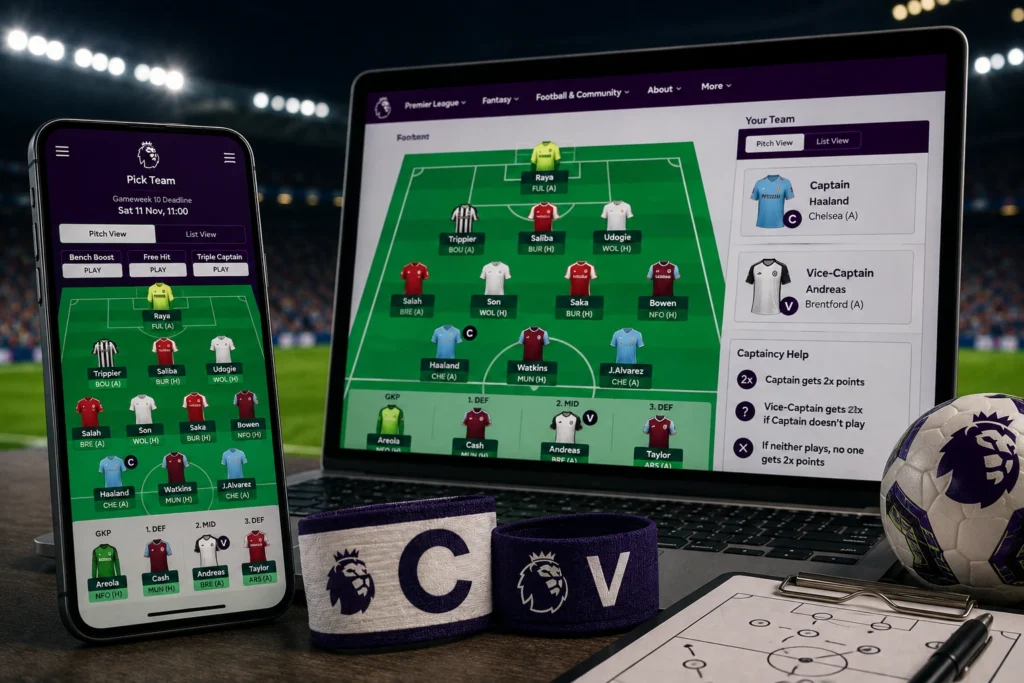
Table of Contents
Choosing your captain is one of the most important decisions you make every Gameweek in Fantasy Premier League.
Your captain normally scores double points, meaning one strong selection can transform your Gameweek. But there is another player managers should not overlook: the vice-captain.
What happens if your captain does not play? Does the vice-captain automatically get double points? What if your captain comes on for only a few minutes? And how does captaincy work during a Double Gameweek or when using Triple Captain?
This guide explains the FPL Captain and Vice-Captain rules, including some of the situations that commonly cause confusion.
How Does the FPL Captain Work?
Before every Gameweek deadline, you must select one player from your starting XI as your captain.
Your captain’s FPL score is normally doubled.
For example:
If your captain scores 8 points, your team receives:
8 × 2 = 16 points
If your captain scores 12 points:
12 × 2 = 24 points
This makes captaincy extremely powerful.
A correct captaincy decision can produce a significant rank gain, while captaining a player who blanks can make even a strong overall team feel disappointing.
How Does the FPL Vice-Captain Work?
You must also choose a vice-captain.
The vice-captain acts as your backup if your selected captain records no playing time during the Gameweek.
If your captain does not play at all, the captaincy automatically moves to your vice-captain.
The vice-captain’s points are then doubled.
Example
Your captain:
0 minutes — 0 points
Your vice-captain:
9 points
The captaincy transfers to your vice-captain.
His final contribution becomes:
9 × 2 = 18 points
This is why the vice-captain should not be treated as an unimportant selection.
When Does the Vice-Captain Replace the Captain?
The key requirement is playing time.
Your vice-captain takes over when your captain records no minutes during the entire Gameweek.
The reason your captain misses the match does not fundamentally matter.
It could be because of:
- Injury
- Illness
- Suspension
- Rotation
- Being left out of the matchday squad
- A postponed fixture that leaves him without an appearance in that Gameweek
If your captain records no playing time, FPL can transfer the captaincy to your vice-captain.
What If Your Captain Plays Only a Few Minutes?
This is one of the most important captaincy rules to understand.
If your captain comes onto the pitch and plays, the vice-captain does not take over simply because the captain played only briefly.
Imagine your captain starts on the bench.
Your vice-captain scores 15 points earlier in the Gameweek.
It looks like you could receive 30 points if your captain stays on the bench.
Then your captain comes on late in his match.
The vice-captain no longer takes over.
Your original captain keeps the armband.
This can be painful, but the rule is based on whether your captain played, not whether your vice-captain scored more points.
Does the Vice-Captain Replace a Low-Scoring Captain?
No.
FPL does not compare their scores.
Suppose:
Captain: 2 points
Vice-captain: 14 points
You do not receive 28 points from the vice-captain.
Your captain played, so his score is doubled:
2 × 2 = 4 points
The vice-captain’s 14 points remain normal points.
The vice-captain is a replacement captain only when the original captain records no playing time.
What Happens If Neither Captain Nor Vice-Captain Plays?
If both players record no playing time during the Gameweek, nobody else receives the captaincy.
FPL does not automatically choose your highest-scoring player.
It also does not move the captaincy to your first substitute.
Instead, you simply receive no doubled score for that Gameweek.
For example:
Captain — 0 minutes
Vice-captain — 0 minutes
Another player — 15 points
That other player’s score remains 15.
It does not become 30.
This is why choosing a reliable vice-captain is important, particularly when your captain has some risk of rotation.
When Are Captain Changes Processed?
Captain changes are processed at the end of the Gameweek, after all matches have been played.
So if your captain does not appear in an early match, you may not immediately see your vice-captain officially receive the armband.
FPL waits until the Gameweek is complete.
This is particularly important when teams have more than one fixture in the same Gameweek.
How Does Captaincy Work in a Double Gameweek?
Double Gameweeks can make captaincy particularly valuable.
If your captain has two fixtures in the same Gameweek, his points from both matches are included before the captain multiplier is applied.
For example:
First match: 6 points
Second match: 8 points
Total: 14 points
As captain:
14 × 2 = 28 points
This is one reason players with two attractive fixtures can become popular captaincy choices during Double Gameweeks.
What If Your Captain Plays Only One Double Gameweek Match?
This rule is extremely important.
Suppose your captain is scheduled to play twice.
He misses the first fixture completely but plays in the second.
Does the captaincy transfer to your vice-captain for the match he missed?
No.
FPL evaluates captaincy across the entire Gameweek.
If your captain records any playing time in any scheduled match during that Gameweek, he remains your captain.
Example
Fixture 1:
0 minutes
Fixture 2:
70 minutes — 5 points
Your captain scores five FPL points across the Double Gameweek.
Those points are doubled to:
10 points
Your vice-captain does not take over for the first fixture.
What If Your Captain Misses Both Double Gameweek Fixtures?
If your captain records zero minutes across both fixtures, he has not played during the Gameweek.
The captaincy can therefore transfer to your vice-captain.
If the vice-captain plays, his Gameweek points receive the captain multiplier.
If your vice-captain also has a Double Gameweek, his points from his qualifying fixtures can therefore become extremely valuable.
This highlights why vice-captain selection deserves extra attention during Double Gameweeks.
What Happens If a Captain’s Match Is Postponed?
Postponements can complicate captaincy.
If a player’s only scheduled fixture is postponed and moved outside the current Gameweek, he may finish the Gameweek with no playing time.
In that situation, the normal captaincy rules apply.
If he records zero minutes during the Gameweek, the captaincy can pass to your vice-captain.
The points from the rescheduled match are not later added to the original Gameweek.
They count in whichever Gameweek the fixture is eventually played.
How Does Triple Captain Work?
The Triple Captain chip changes the normal captain multiplier.
Instead of receiving double points, your captain receives triple points for that Gameweek.
For example:
Captain score:
10 points
Normal captain:
10 × 2 = 20
Triple Captain:
10 × 3 = 30
This makes Triple Captain one of the most powerful chips in FPL when used on the right player.
What Happens If Your Triple Captain Does Not Play?
The Triple Captain chip has an important safety mechanism.
If your Triple Captain records no playing time during the Gameweek, the triple-points bonus passes to your vice-captain, provided the vice-captain plays.
Example
Triple Captain:
0 minutes
Vice-captain:
12 points
Your vice-captain receives:
12 × 3 = 36 points
But there is an important risk.
If both your captain and vice-captain record no playing time, the Triple Captain bonus is lost.
The chip is not returned for future use.
That makes choosing a dependable vice-captain particularly important when activating Triple Captain.
Triple Captain in a Double Gameweek
Double Gameweeks are popular opportunities for the Triple Captain chip because one player may have two matches in which to accumulate points.
Suppose your Triple Captain scores:
Match 1: 8 points
Match 2: 7 points
Total:
15 points
With Triple Captain:
15 × 3 = 45 points
However, two fixtures do not guarantee a big score.
The player could be rotated, substituted early, blank in both matches or play only one fixture.
Managers should therefore evaluate expected minutes and fixture quality rather than automatically using Triple Captain on any player with two matches.
An Important 2026/27 Triple Captain Rule
For the 2026/27 FPL season, managers again receive two sets of chips.
You have a Triple Captain chip available in the first half of the season and another in the second half.
The first set of chips must be used before the Gameweek 19 deadline and cannot be carried into the second half of the campaign.
The chips are then refreshed for the second half.
This means managers can use Triple Captain twice during the 2026/27 season, once in each half.
It adds another strategic dimension to captaincy planning.
Can You Change Your Captain During a Gameweek?
No.
Your captain and vice-captain selections must be saved before the Gameweek deadline.
Once the deadline passes, changes you make will apply to the next Gameweek rather than the current one.
You cannot watch an early match, see your captain blank and then move the armband to another player who has not played yet.
FPL captaincy is locked for the entire Gameweek.
Does Your Captain Need to Be in the Starting XI?
Yes.
Your captain and vice-captain are selected from your starting line-up.
When arranging your team before the deadline, make sure both players are where you want them and that the captaincy selections have been saved.
If your captain subsequently does not play, FPL handles the captain change automatically according to the vice-captain rule.
Can a Captain Score Negative Double Points?
Yes.
Captaincy doubles the player’s FPL score — it does not only double positive points.
Suppose your captain finishes with:
-1 point
Your captain contribution becomes:
-2 points
This can happen through combinations of cards, goals conceded, missed penalties or other negative scoring actions.
The vice-captain does not replace a captain simply because the captain finishes with a negative score.
If the captain played, the multiplier applies.
What Happens to Bonus Points for Your Captain?
Bonus points are part of the player’s final FPL score.
Therefore, if your captain earns bonus points, those points are also included in the amount that gets doubled.
Suppose your captain earns:
2 appearance points
5 points for a goal
3 bonus points
Total:
10 points
As captain:
20 points
The same principle applies to other scoring categories, including assists, clean sheets and defensive contribution points.
How Should You Choose Your FPL Captain?
The best captain is not necessarily the player who scored the most points last week.
Captaincy should be based on expected performance in the upcoming Gameweek.
Important factors include:
- Expected minutes
- Goal threat
- Assist potential
- Fixture difficulty
- Penalty duties
- Set pieces
- Home or away fixture
- Opposition defensive strength
- Player form
- Team attacking strength
- Rotation risk
Because captain points are doubled, reliability and ceiling both matter.
A highly explosive player with a strong fixture and secure minutes can often be an excellent captaincy candidate.
How Should You Choose Your Vice-Captain?
The vice-captain should be someone you would be comfortable captaining if your first choice unexpectedly misses out.
That usually means prioritising:
Secure minutes
A player with a high probability of starting is valuable as backup.
Strong fixture
If your vice-captain is activated, you want him to have genuine scoring potential.
Low rotation risk
Selecting two rotation risks as captain and vice-captain increases the possibility of losing the multiplier entirely.
There can also be value in selecting captain and vice-captain from different clubs when postponement or unexpected team-specific circumstances are a concern.
Should You Captain a Differential?
Sometimes.
Captaining a low-owned player can produce a major rank gain if he delivers while the popular captain blanks.
But the multiplier also increases the cost of getting the decision wrong.
Captaincy should not become differential for the sake of being different.
Ask whether the player genuinely has a better expected outcome than the popular alternative.
If the answer is yes, the differential captain may be justified.
If not, taking unnecessary captaincy risk can hurt your rank quickly.
Why Captaincy Is So Important in FPL
Captaincy effectively gives you an extra copy of one player’s score every Gameweek.
Across a 38-Gameweek season, those decisions accumulate.
A captain returning 10 points gives you an additional 10 through the multiplier.
A captain blanking for two points gives you only two additional points.
Repeated over an entire season, the difference between strong and weak captaincy decisions can become substantial.
That is why captain selection deserves more attention than simply choosing your most expensive player every Friday.
Common FPL Captaincy Mistakes
Ignoring the Vice-Captain
The vice-captain can become extremely important when your captain unexpectedly misses out.
Always select one deliberately.
Assuming the Vice-Captain Takes Over After a Blank
He does not.
Your captain must record no playing time.
A captain who plays and scores one or two points remains captain.
Assuming a Late Substitute Appearance Does Not Count
It does.
If your captain enters the match and records playing time, the captaincy stays with him.
Forgetting Double Gameweek Rules
A captain who misses one fixture but plays the other remains captain.
Choosing Two Rotation Risks
If both captain and vice-captain fail to play, no other player receives the multiplier.
Chasing Last Week’s Points
Previous points can provide useful information, but captaincy should focus on the next fixture rather than the previous score.
FPL Captain and Vice-Captain FAQ
How many points does an FPL captain get?
Your captain receives double his normal FPL score for the Gameweek.
What does the vice-captain do in FPL?
The vice-captain becomes captain if your original captain records no playing time during the Gameweek.
Does the vice-captain get double points if my captain scores zero?
Not necessarily. If your captain plays but finishes on zero points, he remains captain. The vice-captain only takes over when the captain does not play.
What if my captain comes on for only a few minutes?
If he records playing time, he remains captain and his score receives the multiplier.
What happens if both captain and vice-captain don’t play?
No other player becomes captain, so you receive no captain multiplier for that Gameweek.
Does captaincy transfer during a Double Gameweek if my captain misses one match?
No. If your captain plays any minutes in any scheduled fixture during the Gameweek, he remains captain.
What happens if my Triple Captain doesn’t play?
The Triple Captain bonus transfers to your vice-captain if the vice-captain plays. If neither plays, the bonus is lost and the chip is not returned.
Can I change captain after the Gameweek deadline?
No. Changes made after the deadline apply to the following Gameweek.
Are bonus points doubled for captains?
Yes. The captain multiplier applies to the player’s overall FPL score, including any bonus points earned.
Can my captain give me negative points?
Yes. If your captain finishes with a negative FPL score, that negative score is also multiplied.
Final Thoughts
Understanding the FPL Captain and Vice-Captain rules is essential because captaincy has a direct impact on your score every Gameweek.
The fundamental rule is simple:
Your captain’s points are doubled.
If your captain records no playing time during the entire Gameweek, the armband passes to your vice-captain and their points are doubled instead.
But if your captain plays — even briefly — the vice-captain does not take over.
Double Gameweeks make this distinction particularly important because a captain who misses one fixture but plays another remains captain for the entire Gameweek.
Triple Captain increases the stakes even further by changing the multiplier from two to three.
For 2026/27, managers once again have a Triple Captain chip in each half of the season, creating two opportunities to maximise one of FPL’s most powerful decisions.
Choose your captain for upside.
Choose your vice-captain as though you may actually need him.
Because sometimes, you will.