
FPL Bonus Points System Explained for 2026/27
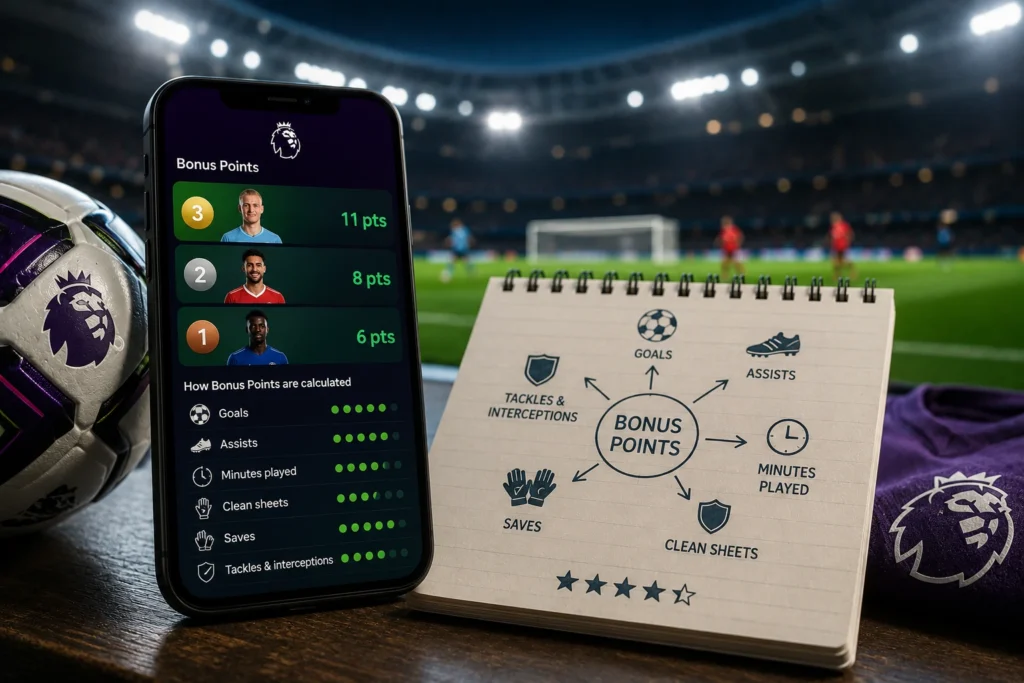
Table of Contents
The FPL Bonus Points System can turn an ordinary Fantasy Premier League score into an excellent one.
A player does not necessarily need to score several goals to earn bonus points. Goals and assists are important, but the system also evaluates a much wider range of actions performed during a Premier League match.
For the 2026/27 season, Fantasy Premier League has made several changes to the Bonus Points System, commonly known as BPS. These adjustments are designed partly to reduce the overlap with defensive contribution points while improving the bonus potential of goalkeepers, full-backs and attacking players.
Understanding how the system works can help FPL managers identify players who have a greater chance of collecting extra points throughout the season.
What Are Bonus Points in FPL?
Bonus points are additional Fantasy points awarded to the best-performing players in each Premier League match.
FPL uses the Bonus Points System to calculate a performance score for every player.
The system uses match statistics supplied by Opta and converts different actions into a BPS score.
At the end of a match, the players with the highest BPS scores are normally awarded:
- 3 bonus points — highest BPS score
- 2 bonus points — second-highest BPS score
- 1 bonus point — third-highest BPS score
These bonus points are added to the player’s normal FPL score.
What Is BPS in FPL?
BPS stands for Bonus Points System.
It is important to distinguish between BPS and actual bonus points.
BPS is the underlying performance score used to rank players within an individual match.
Bonus points are the extra FPL points ultimately awarded according to those rankings.
For example, a player might finish a match with the highest BPS total among everyone on the pitch.
That player would normally receive three actual FPL bonus points.
The player ranked second receives two, while the player ranked third receives one.
How Are FPL Bonus Points Calculated?
The BPS evaluates many different events that happen during a match.
This means a player’s bonus potential is not determined solely by goals and assists.
The system can take into account positive actions such as scoring, creating opportunities, completing passes, keeping a clean sheet and making saves.
Negative actions can also reduce a player’s BPS total.
The final result is a performance score that allows FPL to compare the players involved in that specific match.
Because of this, two players who receive the same number of regular Fantasy points can finish with very different BPS totals.
Why Do Goals Matter So Much for BPS?
Goals are naturally among the most influential actions in Fantasy football.
However, their BPS value depends partly on the player’s position.
This helps explain why a defender or midfielder scoring a goal can sometimes become particularly competitive for bonus points.
But a goal does not automatically guarantee three bonus points.
A player can score and still miss out if other players produce stronger overall BPS performances.
That is why looking only at goals can sometimes give managers the wrong impression about who will receive the bonus.
Do Assists Help Players Earn Bonus Points?
Yes.
Assists contribute positively toward BPS and can help a player climb the bonus rankings.
But, as with goals, an assist is only one part of the calculation.
A player who provides an assist but performs poorly in other BPS categories may be overtaken by a teammate who produces a more complete performance.
This is one reason bonus rankings can change considerably during a match.
Clean Sheets and BPS
Clean sheets can also influence the Bonus Points System.
This is particularly relevant to goalkeepers and defenders.
A defender who keeps a clean sheet while also contributing effectively in other areas may become a strong bonus candidate.
Goalkeepers can similarly benefit from a combination of clean-sheet performance and saves.
However, the introduction of defensive contribution points created some overlap between defensive performance and BPS.
FPL has therefore adjusted the system for 2026/27.
Defensive Actions and the 2026/27 BPS
One important change concerns clearances, blocks and interceptions, commonly grouped as CBI.
In 2025/26, a player earned one BPS for every two CBI.
For 2026/27, a player instead receives one BPS for every three CBI.
The change is significant for centre-backs.
Defenders who make large numbers of clearances, blocks and interceptions can already earn separate defensive contribution points.
Reducing the BPS reward for these actions should decrease the frequency with which the same defensive actions contribute heavily toward both scoring mechanisms.
Defensive Contribution Points vs Bonus Points
These are two different FPL scoring mechanisms.
Defensive contribution points are actual Fantasy points awarded when players reach specified defensive-action thresholds.
For 2026/27, a defender earns two FPL points after reaching a combined total of 10 clearances, blocks, interceptions and tackles in a match.
Midfielders and forwards can earn two points after reaching 12 qualifying defensive contributions, with ball recoveries also included for those positions.
Those points are separate from bonus points.
A player can potentially receive both, although the 2026/27 BPS changes are intended to reduce some of the overlap between the two systems.
Players Are No Longer Penalised for Being Tackled
Another important 2026/27 change affects attacking players.
Previously, a player lost one BPS whenever they were tackled.
That penalty has now been removed.
This could particularly benefit players who regularly attempt to dribble past opponents.
Wingers, attacking midfielders and adventurous full-backs often take on defenders and therefore naturally risk losing possession.
Removing this BPS penalty means those players are no longer directly punished simply for being tackled while attempting a dribble.
Goalkeeper BPS Changes for 2026/27
Goalkeepers also receive important changes.
Previously, the BPS differentiated between saves from shots taken inside and outside the penalty area.
For 2026/27, goalkeepers receive two BPS for any save, regardless of where the shot originates.
They continue to receive an additional BPS for a save from inside the penalty area.
There is also a new reward for particularly important saves.
A goalkeeper now receives an additional one BPS for saving a big chance.
This increases the potential BPS value of goalkeepers who regularly make difficult saves.
What About Penalty Saves?
Penalty saves remain extremely valuable.
Because penalties qualify as big chances, the underlying BPS allocation has been adjusted.
The specific penalty-save reward has fallen from eight BPS to seven BPS for 2026/27, but the goalkeeper receives the additional one BPS for saving a big chance.
The overall reward therefore avoids being artificially increased simply because the same save qualifies under both categories.
Can Players Tie for Bonus Points?
Yes.
FPL has specific rules for BPS ties.
If two players tie for first place, both receive three bonus points and the next player receives one.
If there is a tie for second, the highest-ranked player receives three bonus points while the two tied players receive two each.
If there is a tie for third, the first player receives three, the second receives two and the players tied for third receive one each.
This is why more than three players can sometimes receive bonus points from the same match.
Why Can Bonus Points Change After a Match?
The numbers you see immediately after the final whistle are not necessarily final.
Match statistics can be reviewed and corrected.
An action may subsequently be reclassified, which can alter the BPS standings and therefore the allocation of bonus points.
This becomes particularly relevant in 2026/27 because FPL has changed when Gameweek scores become final.
When Are FPL Scores Final in 2026/27?
For 2026/27, the Gameweek lockdown takes place at 09:00 UK time on the day after the final match of the Gameweek.
Previously, the Gameweek was finalised one hour after the final whistle of its last match.
The additional review period gives post-match Opta data more time to be reflected in BPS and defensive contribution calculations.
Therefore, managers should avoid assuming that every displayed score is final immediately after the final match ends.
Live Bonus Points in 2026/27
Another major change for the new season is how managers follow bonus points during matches.
Projected bonus points are now added to player scores after 20 minutes of a match.
Those projections can then change throughout the game as players move up and down the BPS rankings.
This provides a much clearer live picture of how a Gameweek is developing.
A goal, assist, save or other important action can immediately affect both a player’s projected bonus and your live Fantasy score.
But these remain projected values until scores are eventually confirmed.
Why Some Players Are Better at Earning Bonus Points
Some FPL players appear to collect bonus points more consistently than others.
This usually happens because their playing style produces several BPS-positive actions.
An attacking player might combine goals with assists and chance creation.
A goalkeeper might combine a clean sheet with several important saves.
An attacking full-back might contribute at both ends of the pitch.
The key is involvement.
Players who influence matches in several different ways generally have more opportunities to build competitive BPS totals.
Does the Match Score Affect Bonus Potential?
Very much so.
Imagine a match ending 1-0.
The only goalscorer may have a strong chance of earning bonus, but defenders and the goalkeeper from the winning side can also become serious contenders because of the clean sheet.
Now compare that with a 4-3 match.
There may be several goalscorers and assist providers competing for the highest BPS positions.
The context of each match therefore matters.
Bonus potential cannot always be predicted simply from a player’s normal FPL points.
Why Bonus Points Matter for FPL Strategy
One or two bonus points may not appear significant in isolation.
Across an entire season, however, they can add up.
A player who regularly turns six-point returns into eight or nine points can become considerably more valuable than another player with similar headline statistics.
This is particularly useful when comparing players in the same price range.
Goals, assists, clean sheets, minutes and fixtures should remain major considerations, but bonus potential can provide an additional factor when two players otherwise appear closely matched.
Should You Pick Players Mainly for Bonus Potential?
Usually not.
Bonus potential should complement your analysis rather than dominate it.
The fundamentals remain important:
- expected minutes;
- attacking threat;
- assist potential;
- clean-sheet prospects;
- fixtures;
- price;
- role within the team.
A player who is excellent at accumulating BPS but rarely produces meaningful Fantasy returns is unlikely to become an essential option purely because of bonus potential.
Instead, bonus points can help distinguish between players who already have strong FPL prospects.
How to Use BPS When Comparing Players
Suppose two defenders have similar prices, fixtures and expected minutes.
One regularly becomes involved in matches through attacking actions, clean sheets and other BPS-positive contributions.
The other tends to rely almost entirely on clean sheets.
The first defender may have a higher ceiling because successful Gameweeks can also produce bonus points.
The same principle can apply to midfielders, forwards and goalkeepers.
Looking at how players earn their points can therefore be more useful than simply comparing their total scores.
What the 2026/27 Changes Mean for FPL Managers
The changes suggest a subtle shift in the type of players who can compete strongly for bonus points.
Reducing the CBI reward should make it slightly harder for centre-backs to dominate BPS through defensive volume alone.
Removing the penalty for being tackled can help attacking players and dribblers.
The goalkeeper changes provide greater recognition for saves, particularly saves from big chances.
Together, these adjustments are intended to improve bonus prospects for goalkeepers, full-backs and attacking players, while reducing duplication with defensive contribution points.
That does not mean centre-backs suddenly become poor FPL choices.
Defensive contribution points continue to reward their defensive work directly.
Instead, managers should understand that the two systems now have somewhat more distinct purposes.
Final Thoughts
The FPL Bonus Points System rewards more than the most obvious actions on the pitch.
Opta statistics are used to build a BPS score for every player, with the leading performers normally receiving three, two and one additional Fantasy points.
For 2026/27, several important details have changed.
Players are no longer penalised in BPS for being tackled, clearances, blocks and interceptions provide less BPS than before, and goalkeeper saves have been adjusted to give greater recognition to important stops.
Projected bonus points also appear during matches from the 20-minute mark, while final Gameweek scores are confirmed later to allow additional time for statistical reviews.
Understanding these rules will not tell you exactly who will earn bonus points every week.
But it can help you understand why certain players consistently turn good FPL returns into even better ones.