
FPL Price Change Predictor Explained: How to Track Risers and Fallers
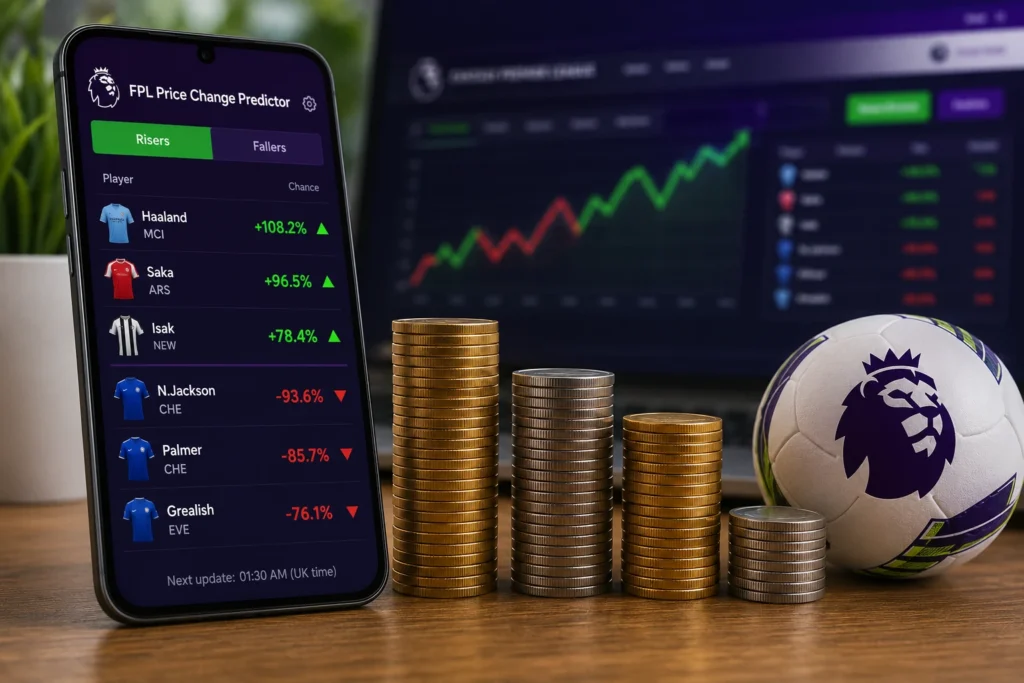
Table of Contents
Price changes can have a major impact on your Fantasy Premier League season. Missing a £0.1m rise can price you out of a planned transfer, while holding a heavily sold player through a price drop can reduce your available budget.
For the 2026/27 FPL season, managers have a powerful new resource to help manage this problem: the official FPL Price Change Predictor.
The tool uses official Fantasy Premier League data to track transfer activity for every player and provides an indication of who could rise or fall at the next daily price update.
But how reliable is the Predictor? What does a percentage above 100% actually mean? And should you make an early transfer just to avoid a price change?
This guide explains how the FPL Price Change Predictor works and how you can use it to make smarter transfer decisions.
What Is the FPL Price Change Predictor?
The FPL Price Change Predictor is an official Fantasy Premier League feature introduced for the 2026/27 season.
It monitors player transfer activity and shows how each player is progressing towards a possible price increase or decrease.
After the Gameweek 1 deadline, FPL will provide a dedicated page displaying the current progress of all players towards a price rise or fall as a percentage.
Managers can sort the table to identify the players closest to rising or falling and filter the information by:
- Your squad
- Your watchlist
- All FPL players
This represents a major change from previous seasons.
Managers have traditionally relied on transfer statistics or unofficial third-party prediction tools to estimate potential price movements. The new Predictor brings price-change information directly into Fantasy Premier League using official FPL data.
How Does the FPL Price Change Predictor Work?
FPL prices are influenced by activity in the transfer market.
Players receiving enough transfers in can move towards a price rise, while players being heavily transferred out can move towards a price fall.
The exact FPL price-change formula remains undisclosed.
Instead of revealing the algorithm or exact thresholds, the Price Change Predictor displays a player’s progress towards a possible change.
This is presented as a percentage.
After an initial calibration period using live 2026/27 data, FPL will also introduce a predicted progress percentage.
This should provide managers with an additional indication of whether the player’s current transfer activity is likely to result in a price change.
What Does 100% Mean on the FPL Price Change Predictor?
The percentage is one of the most important parts of the new system.
FPL states that a reading above 100% indicates that the player is expected to surpass the relevant threshold when the next set of price changes takes place.
For example, imagine a player is showing:
105% towards a price rise
That suggests he is expected to cross the threshold and increase in price at the next update.
However, it is important to understand one key word:
Expected.
A reading above 100% does not guarantee that the player’s price will change.
Transfer activity continues until the daily price-change deadline.
If a player is at 105% but suddenly receives enough transfers out before the update, his progress could fall below the required level.
The Predictor should therefore be treated as a powerful guide rather than a guaranteed forecast.
When Do FPL Prices Change in 2026/27?
For the 2026/27 season, FPL has provided managers with a much clearer schedule.
Potential player price changes take place every day at:
00:00 UK time
Whether a player’s price actually rises or falls at that point depends on activity in the FPL transfer market.
This is particularly useful for transfer planning.
If one of your targets is approaching a predicted rise during the evening, you know exactly how long you have to decide whether to complete the transfer before the next price update.
How Often Is the Price Change Predictor Updated?
The official Price Change Predictor data is updated every:
15 minutes
This means percentages can change considerably throughout the day.
A player who looks relatively safe in the morning could move much closer to a price change after thousands of managers make transfers later in the day.
The opposite can also happen.
A strong transfer trend can slow down or reverse before midnight.
For that reason, the latest Predictor reading is generally more relevant than a percentage recorded many hours earlier.
Are FPL Prices Changing Before Gameweek 1?
No.
Although Fantasy Premier League is already live for 2026/27, prices are initially locked.
For the new season, player prices remain fixed until the Gameweek 1 deadline on Friday 21 August 2026 at 18:30 BST.
This means pre-season transfers between players in managers’ drafts will not trigger price rises or falls.
Normal price changes begin once Gameweek 1 is underway.
How Much Can an FPL Player’s Price Change?
Once the season starts, a player’s price may change by £0.1m in a day based on transfer-market activity.
Historically, players have tended to rise or fall by a maximum total of around £0.3m during a Gameweek.
Although £0.1m might sound insignificant, it can have an important effect on transfer plans.
Imagine you have exactly £7.5m available for a midfielder.
Your target costs £7.5m.
If he rises to £7.6m before you make the transfer, you are priced out.
You would then need to find another £0.1m elsewhere in your squad or choose a different player.
Why Do FPL Player Prices Rise?
Price rises are driven by transfer-market activity.
When a player becomes a popular transfer target, heavy buying can move him towards the threshold required for an increase.
This often happens after:
- A big Gameweek score
- Goals or assists
- Improved upcoming fixtures
- Increased playing time
- A new attacking role
- An injury to another popular FPL player
- Strong performances from a cheap player
Bandwagons can develop extremely quickly.
A player who produces a major return on Saturday afternoon could receive huge numbers of transfers before the weekend is over.
The Price Change Predictor helps managers determine whether that activity is actually pushing him close to a rise.
Why Do FPL Player Prices Fall?
The reverse happens when managers sell a player heavily.
Common reasons include:
- Injury
- Suspension
- Poor form
- Rotation risk
- Loss of a starting position
- Difficult fixtures
- A more attractive alternative becoming available
Monitoring fallers can be just as important as tracking risers.
If you already plan to sell a player and he is close to a price drop, completing the transfer before midnight could preserve £0.1m of your budget.
However, price alone should never be the only reason to sell a good FPL asset.
Understanding FPL Purchase Price and Selling Price
There is another important rule to understand when managing price changes.
If a player you own rises in value, you do not necessarily receive his full current price when you sell him.
FPL gives you £0.1m of selling-price profit for every £0.2m increase while you own the player.
Example 1
You buy a player for:
£5.0m
He rises to:
£5.4m
Other managers now need £5.4m to buy him.
Your selling price, however, is:
£5.2m
Example 2
You buy at:
£5.0m
The player rises to:
£5.3m
Your selling price becomes:
£5.1m
Example 3
You buy at:
£5.0m
The player rises once to:
£5.1m
Your selling price remains:
£5.0m
This distinction between purchase price, current price and selling price is essential when planning transfers.
Where Can You See the Price Change Predictor?
FPL has integrated price-change information into several areas of the game.
The main Predictor page will allow managers to see all players and sort them according to their likelihood of rising or falling.
But you will not always need to visit that page.
Player profiles will also show a status message indicating the likelihood of a price change.
FPL has additionally introduced new squad views.
On the Pick Team and Transfers screens, managers can select the Price Change Predictor view to see whether players in their squad are approaching a rise or fall.
This makes price information much easier to incorporate into normal squad management.
What Do “Likely” and “Very Likely” Mean?
FPL will not rely exclusively on percentages.
The game will also use status messages such as:
Likely to rise
Very likely to rise
Likely to fall
Very likely to fall
These labels make the Predictor easier to understand at a glance.
Early in the season, these messages will initially be based on current progress.
After FPL has collected enough live data for calibration, they will transition towards the predicted progress system.
How to Track FPL Price Risers
The best way to use the Predictor is to start with players you already want.
Do not begin with:
“Who is rising?”
Begin with:
“Who improves my FPL team?”
Then check whether price movements should affect the timing of the transfer.
Suppose you have identified a midfielder with excellent fixtures, secure minutes and strong attacking potential.
You already intend to buy him.
If the Price Change Predictor shows that he is very likely to rise before midnight and you only have exactly enough money to complete the transfer, making the move early could be sensible.
In this situation, the Predictor helps you execute a transfer you already wanted.
How to Track FPL Price Fallers
The same principle applies to players you intend to sell.
Imagine you have already decided that a £6.0m midfielder needs to leave your team.
The Predictor shows that he is very likely to fall at midnight.
If there is no important information you are waiting for, selling before the decrease could protect your budget.
But selling purely because a player might lose £0.1m is different.
A good FPL player with excellent fixtures can easily repay that small loss through points.
Price information should influence timing, not automatically determine the transfer itself.
Should You Make Early Transfers to Beat Price Changes?
This is one of the biggest strategic questions in FPL.
There are advantages to acting early.
You can:
- Beat a price rise
- Avoid a price fall
- Protect your planned transfer
- Increase team value
But there are also risks.
After making an early transfer, your new player could:
- Get injured
- Become ill
- Pick up a knock in training
- Play in a European or cup match
- Lose his starting place
- Become affected by unexpected team news
Another player already in your squad could also become unavailable after you have used your free transfer.
This creates a trade-off between:
Price information vs team information
Sometimes protecting £0.1m is worth the risk.
Sometimes waiting until closer to the deadline is far more valuable.
Price Changes vs FPL Points
The objective of Fantasy Premier League is not to finish the season with the highest team value.
It is to score the most points.
Building squad value can certainly help.
If your team grows beyond the initial £100.0m budget, you may eventually be able to afford combinations of premium players that other managers cannot.
But team value is only useful if it helps produce points.
Managers who chase every price rise can easily make unnecessary transfers or buy players based on popularity rather than actual FPL potential.
The best approach is therefore:
Player quality first. Price timing second.
How Accurate Is the FPL Price Change Predictor?
Even though this is an official FPL tool using official data, its predictions are not guaranteed.
FPL explicitly describes the information as a guide.
The reason is simple.
Transfer activity is constantly changing.
A player could appear likely to rise several hours before midnight and then experience a significant change in transfers.
Likewise, a player who initially appears unlikely to change could suddenly become extremely popular after important news.
This is why the Predictor provides probability-style information rather than confirming price changes in advance.
How Often Should You Check the Predictor?
There is little reason to monitor the Predictor every few minutes.
For normal squad management, checking once during the day may be enough.
More frequent monitoring becomes useful when:
- You have exactly enough money for a transfer
- Your target is approaching a rise
- A player you plan to sell is approaching a fall
- Transfer activity is moving rapidly
- You intend to make an early transfer
Because the data updates every 15 minutes, the latest reading near midnight can provide useful information when a decision is particularly close.
Can Multiple FPL Players Change Price at the Same Time?
Yes.
The system is not limited to a single riser or faller.
Multiple players can rise or fall during the same daily update depending on transfer-market activity.
This is why the Predictor includes all players rather than simply highlighting one potential change.
Managers can sort the list to identify the strongest rise and fall candidates across the entire FPL market.
How to Use the Price Change Predictor Effectively
The Predictor works best when combined with other FPL information.
Before buying a likely riser, consider:
- Upcoming fixtures
- Expected minutes
- Injury status
- Form
- Tactical role
- Attacking or defensive potential
- Rotation risk
- Price
- Your long-term transfer plan
Then use the Predictor to decide when to make the move.
This prevents price changes from becoming the strategy themselves.
A £0.1m rise on a poor transfer does not suddenly make it a good transfer.
Likewise, accepting a £0.1m price change can sometimes be worthwhile if waiting gives you valuable team information.
FPL Price Change Predictor FAQ
Is the FPL Price Change Predictor an official FPL tool?
Yes. The Price Change Predictor is a new official Fantasy Premier League feature for the 2026/27 season.
When do FPL prices change?
Player prices can change each day at 00:00 UK time once the season is underway.
How often does the Predictor update?
The Price Change Predictor page updates its data every 15 minutes.
Does a reading above 100% guarantee a price change?
No. Above 100% means the player is expected to surpass the relevant threshold, but transfer activity can still change before the midnight update.
Can FPL reveal the exact price-change threshold?
No. The exact formula includes variable factors and is not disclosed to managers.
How much can a player’s price change in one day?
A player can rise or fall by £0.1m in a day once price changes are active.
Do prices change before Gameweek 1?
No. For 2026/27, player prices are locked until the Gameweek 1 deadline on 21 August 2026 at 18:30 BST.
Can I see Price Change Predictor information for my own team?
Yes. FPL’s new squad views allow managers to see price-change information for their players directly from relevant squad screens.
Should I always buy a player before his price rises?
No. A likely rise should influence the timing of an already sensible transfer, not convince you to buy a player who does not fit your FPL strategy.
Final Thoughts
The FPL Price Change Predictor is one of the most useful additions to Fantasy Premier League for the 2026/27 season.
Instead of relying entirely on raw transfer numbers or external estimates, managers can now use official FPL data to see how players are progressing towards potential price rises and falls.
With data refreshing every 15 minutes and price changes taking place daily at 00:00 UK time, the tool can help managers avoid being priced out of planned transfers and protect their squad value.
But the most important principle remains unchanged.
FPL is about points, not money.
Use the Price Change Predictor to improve the timing of good decisions rather than allowing price movements to dictate your strategy.
If you combine it with fixtures, minutes, player roles, injuries and long-term planning, it can become a valuable part of your FPL transfer process throughout the 2026/27 season.