
FPL Rules 2026/27 Explained: Complete Fantasy Premier League Beginner’s Guide
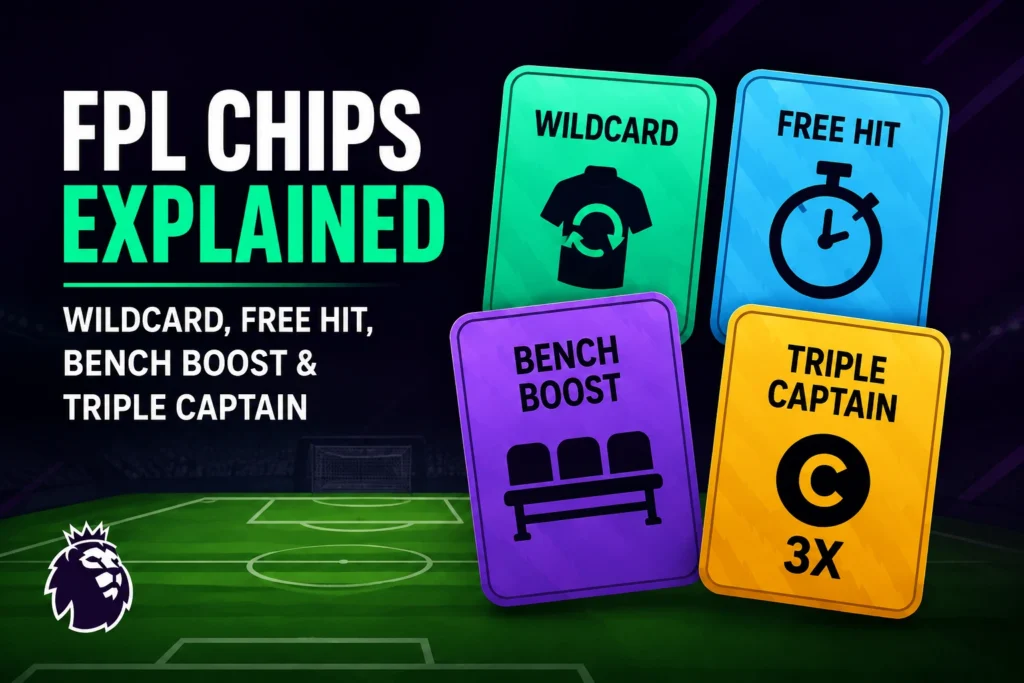
Table of Contents
Fantasy Premier League can look complicated when you first create a team. You have a £100.0m budget, 15 squad places to fill, transfers to manage, captains to select, chips to use and millions of other managers to compete against.
Fortunately, the basic FPL rules are straightforward once you understand how the game works.
This complete Fantasy Premier League beginner’s guide explains the key FPL rules for the 2026/27 season, from building your first squad to scoring points, making transfers, using chips and competing in mini-leagues.
Whether you are playing FPL for the first time or returning for another season, understanding these rules is the foundation of a successful Fantasy campaign.
What Is Fantasy Premier League?
Fantasy Premier League, commonly known as FPL, is the official fantasy football game of the Premier League.
You create a virtual squad using real Premier League players. Those players then earn Fantasy points according to what happens in actual Premier League matches.
Goals, assists, clean sheets, saves, defensive contributions and bonus points can all contribute to your Gameweek score.
Your objective is simple: score as many points as possible across the season.
You can compete for your overall rank while also joining private mini-leagues with friends, colleagues and other FPL managers.
How Do You Build an FPL Squad?
Every manager starts with a budget of £100.0 million.
You must use that budget to select a squad of 15 players:
- 2 goalkeepers
- 5 defenders
- 5 midfielders
- 3 forwards
You cannot simply select every premium player you want because the total value of your squad must remain within your available budget.
FPL therefore rewards managers who can find the right balance between expensive stars and good-value players.
You are also limited to a maximum of three players from any one Premier League club.
For example, if you already own three Arsenal players, you cannot add another Arsenal player unless you transfer one of your existing three out.
How Does Your Starting XI Work?
Although your full squad contains 15 players, only 11 players start each Gameweek.
The other four players form your bench.
Your starting XI must always contain:
- 1 goalkeeper
- At least 3 defenders
- At least 1 forward
This allows several legal formations, including:
- 3-4-3
- 3-5-2
- 4-4-2
- 4-3-3
- 4-5-1
- 5-3-2
- 5-4-1
- 5-2-3
FPL automatically prevents you from selecting an invalid formation.
How Do FPL Points Work?
Your players score points based on their performances in real Premier League matches.
The scoring system rewards a range of actions, including goals, assists, clean sheets, saves and strong individual performances.
Position matters too.
For example, a defender receives more points for scoring a goal than a forward because goals are generally less common for defenders.
Players can also lose points for certain events, including red cards, own goals and missed penalties.
Understanding the scoring system is important because the best real-world football player is not always the best FPL asset.
A player’s position, role, minutes, attacking potential, defensive output and price can all affect their Fantasy value.
How Do FPL Bonus Points Work?
In addition to regular Fantasy points, players can earn bonus points.
FPL uses its Bonus Points System (BPS) to evaluate performances in each match.
The highest-ranked players normally receive:
- 3 bonus points for first
- 2 bonus points for second
- 1 bonus point for third
Special rules apply when players are tied on BPS.
The BPS itself considers many match actions, which means goals and assists aren’t the only ways players can perform well in the system.
The Bonus Points System has also received adjustments for the 2026/27 season, making it worth understanding separately when evaluating players.
What Are Defensive Contribution Points?
Defensive Contribution points were introduced in 2025/26 and remain part of FPL in 2026/27.
They reward outfield players for defensive work that historically did not generate many direct Fantasy points.
For defenders, reaching 10 combined clearances, blocks, interceptions and tackles (CBIT) in a match earns two FPL points.
Midfielders and forwards have a different threshold and can also count recoveries toward their qualifying defensive actions. Defensive Contribution points are capped at two per player per match.
This system can make centre-backs and defensive midfielders more interesting Fantasy options than they were under the traditional scoring system.
How Do Captain and Vice-Captain Points Work?
Each Gameweek you choose:
- One captain
- One vice-captain
Your captain normally receives double points.
If your captain scores 10 points, for example, you receive 20 points from that player.
The vice-captain acts as your backup.
If your captain plays no minutes during the entire Gameweek, the captaincy passes to your vice-captain, provided the vice-captain plays.
Choosing the right captain is therefore one of the most important decisions you make each Gameweek.
FantasyFanZone’s Captain Picks tool can help you evaluate captaincy options before the deadline.
How Do FPL Transfers Work?
Your initial squad will not remain perfect throughout the season.
Players get injured, lose form, face difficult fixtures or become less attractive than other options. Transfers allow you to replace them.
If you do not use a free transfer, it can roll over to the following Gameweek.
For 2026/27, managers can continue to accumulate up to five free transfers.
Once you have confirmed a normal transfer, however, it cannot simply be cancelled.
Making transfers beyond your available free transfers normally results in a points deduction.
This creates one of FPL’s most important strategic decisions:
Is bringing in a new player worth spending additional points?
Good FPL management isn’t about making as many transfers as possible. Sometimes keeping a free transfer is the better decision.
How Do Player Price Changes Work?
FPL player prices can change during the season according to transfer-market activity within the game.
A player’s price can move by £0.1m per day once the season has started, although FPL does not publicly reveal the exact formula or timing used to determine changes.
Popular players receiving large numbers of transfers can increase in value, while heavily sold players can fall.
Price movements matter because they affect your purchasing power throughout the season.
FantasyFanZone already has two useful resources covering this subject:
How Do Automatic Substitutions Work?
Your bench isn’t only there for decoration.
If one of your starting outfield players plays zero minutes during a Gameweek, FPL may automatically substitute a bench player into your team.
Bench priority matters, but your final XI must still satisfy the formation rules.
For example, if you started with only three defenders and one of those defenders didn’t play, an attacking bench player cannot replace that defender if doing so would leave you with only two defenders.
Your substitute must produce a valid formation.
Goalkeepers are handled separately: your substitute goalkeeper can replace your starting goalkeeper if the starter doesn’t play.
Automatic substitutions are processed after the Gameweek has finished.
What Are FPL Chips?
Chips allow you to temporarily change some of the normal FPL rules or significantly increase your scoring potential.
The four chip types are:
Wildcard
The Wildcard allows you to make unlimited transfers without transfer-point deductions.
Unlike Free Hit transfers, your Wildcard changes are permanent.
FantasyFanZone already has dedicated guides explaining this chip:
Free Hit
Free Hit allows you to make unlimited transfers for one Gameweek only.
At the following deadline, your previous squad returns.
This can be especially useful when unusual fixture schedules leave many of your normal players without matches.
Bench Boost
Bench Boost makes the points scored by your bench count toward your Gameweek total.
Instead of receiving points only from your starting XI, all 15 squad players can contribute.
Triple Captain
Triple Captain changes your captain multiplier from ×2 to ×3 for that Gameweek.
A captain who scores 12 normal points would therefore contribute 36 points.
How Many Chips Do You Get in FPL 2026/27?
This is particularly important for managers returning after older FPL seasons.
For 2026/27, managers receive two sets of chips.
Each half-season contains:
- 1 Wildcard
- 1 Free Hit
- 1 Bench Boost
- 1 Triple Captain
That means managers have eight chip uses in total across the season.
The first set must be used before the Gameweek 19 deadline and cannot be carried into the second half of the season. A fresh set is then available for the second half.
Only one chip can be active in a Gameweek.
This makes chip planning considerably more important than simply saving everything for the final months of the season.
What Is an FPL Gameweek Deadline?
Every Gameweek has a deadline.
Your transfers, starting XI, bench order, captain and chip decisions need to be completed before that deadline if you want them to apply to the upcoming Gameweek.
Changes made after a deadline apply to the following Gameweek instead.
This is why checking injuries, press conferences and team news before committing to an early transfer can be valuable.
But waiting also carries a potential price-change risk.
Managing that trade-off is a fundamental part of FPL strategy.
What Is a Double Gameweek?
A Double Gameweek (DGW) happens when a Premier League club plays twice within the same FPL Gameweek.
A player from that club can earn points from both matches.
This can make Double Gameweeks particularly attractive for:
- Captaincy
- Triple Captain
- Bench Boost
- Transfers
- Wildcard planning
If a player participates in only one of their club’s two scheduled matches, however, they are still considered to have played in the Gameweek and won’t be automatically substituted for the match they missed.
What Is a Blank Gameweek?
A Blank Gameweek (BGW) occurs when one or more Premier League clubs have no fixture during that FPL Gameweek.
Players from those clubs score zero because they have no match.
Postponed fixtures are normally rearranged for another Gameweek, which can eventually create a Double Gameweek.
This relationship between blanks and doubles is one reason experienced managers plan transfers and chips several Gameweeks ahead.
How Do FPL Mini-Leagues Work?
You don’t have to compete only against millions of managers worldwide.
FPL allows you to join private leagues and compete directly with friends or communities.
Classic leagues rank managers according to their accumulated Fantasy points, while Head-to-Head formats create direct weekly matchups.
You can enter your same FPL team into multiple leagues; you do not need to create separate squads.
FantasyFanZone also has its own community league: FantasyFanzone League
What’s New in FPL for 2026/27?
The core Fantasy Premier League experience remains familiar, but the 2026/27 season includes several notable improvements.
Among the new features announced by the Premier League are an official Price Change Predictor, live updating league rankings during matches, projected bonus-point information, new squad-view options and a Rookie League for eligible first-season managers.
The time when a Gameweek becomes final has also moved later. Scores now lock at 09:00 UK time on the day after the final match of the Gameweek, allowing additional time for post-match data reviews affecting BPS and Defensive Contribution scoring.
There are also changes to the Bonus Points System.
At the same time, some important 2025/26 features remain, including Defensive Contribution points and two sets of chips.
One thing that does not return is the special allocation of additional free transfers that was used around AFCON last season, because the tournament does not fall within the 2026/27 FPL campaign.
Simple FPL Strategy for Beginners
Knowing the FPL rules is only the first step. Using them effectively is where strategy begins.
For a new manager, a few principles can make the game considerably easier:
Prioritise minutes. A talented player who rarely starts is difficult to rely on.
Look beyond last week’s points. One big score doesn’t automatically make someone a good transfer.
Think about upcoming fixtures. Buying a player for several favourable Gameweeks can be more effective than chasing yesterday’s points.
Don’t spend points on unnecessary transfers. A transfer hit needs to generate enough value to justify its cost.
Choose your captain carefully. Captaincy has an outsized impact because of the points multiplier.
Plan chips rather than using them impulsively. Double and Blank Gameweeks can create opportunities later in the season.
And most importantly, don’t expect every decision to work. FPL combines analysis with uncertainty. Good strategy improves your chances; it doesn’t eliminate variance.
Use FantasyFanZone’s FPL Tools
Understanding the rules becomes much more useful when you can apply them to real decisions.
FantasyFanZone provides several tools designed to help with Gameweek planning, including:
- Suggested Lineup
- Captain Picks
- Fixtures
- Price Changes
- Transfer Trends
- Best Squad
- Player Comparison
- Premier League Standings
- FFZ League
Rather than treating statistics in isolation, use these tools alongside fixture difficulty, player form, availability and your own squad needs.
FPL Rules 2026/27 FAQ
How much money do you get in FPL?
Managers start with a £100.0m budget to build their initial 15-player squad.
How many players are in an FPL squad?
An FPL squad contains 15 players: two goalkeepers, five defenders, five midfielders and three forwards.
How many players can you have from one Premier League club?
You can normally select a maximum of three players from the same club.
How many free transfers can you save?
Managers can accumulate up to five free transfers.
How many chips are there in FPL 2026/27?
There are four types Wildcard, Free Hit, Bench Boost and Triple Captain but managers receive one set in each half of the season, giving eight chip uses in total.
Can you use two chips in the same Gameweek?
No. Only one chip can be active per Gameweek.
What happens if my FPL captain doesn’t play?
If your captain plays zero minutes, captaincy passes to your vice-captain if the vice-captain plays.
Can I change my team after the Gameweek deadline?
You can make changes, but they will apply to the next Gameweek rather than the one whose deadline has already passed.
Final Thoughts
The FPL rules may seem extensive at first, but the basic idea is simple: build a 15-player squad within your budget, select your best XI, manage transfers carefully and score points from real Premier League performances.
Once you understand squad structure, scoring, transfers, captaincy, substitutions and chips, you already have everything you need to start playing.
The next step is learning how to use those rules strategically.
FantasyFanZone will continue to provide tools, analysis and guides throughout the 2026/27 season to help you make better-informed Fantasy decisions.